
Unified Communications Platform: Options and How to Choose
Compare unified communications proposals with a practical checklist for call flows, CRM connections, ownership and a small business pilot.
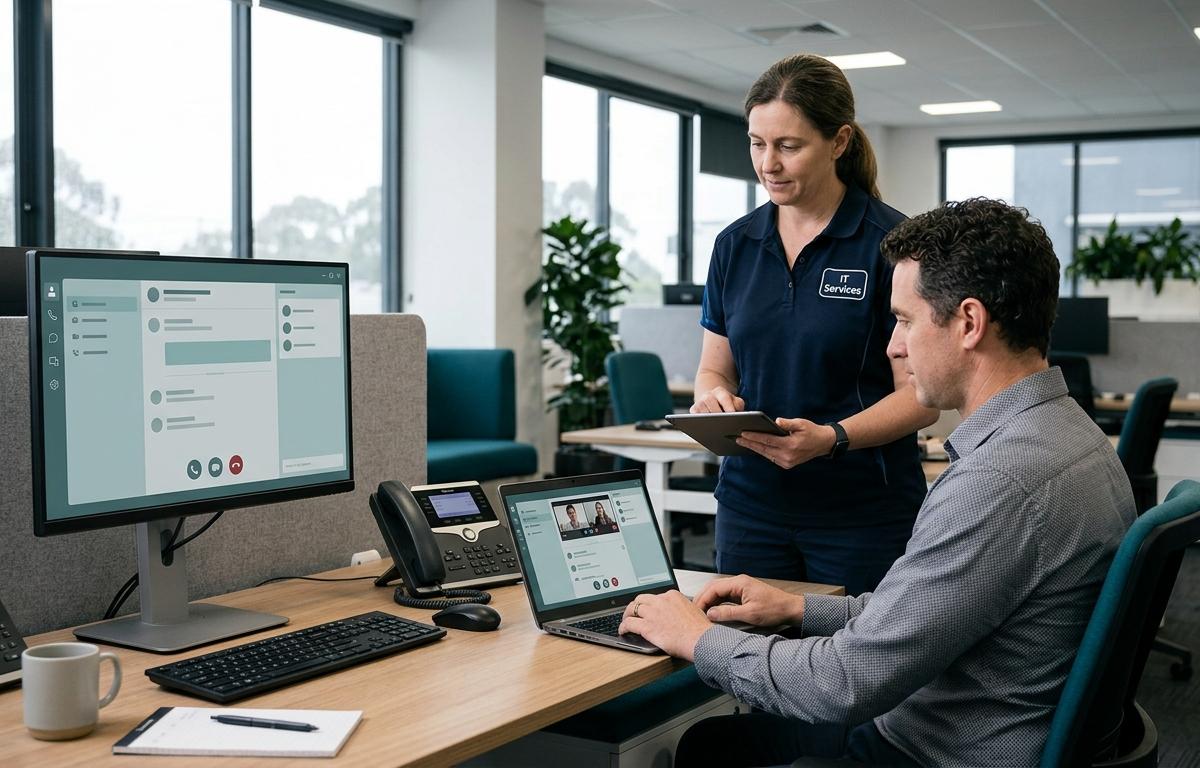
Illustrative image.
Illustrative image: the people and office shown are not identified as Bestcomm staff or a client project.
Start with the conversations your team handles
Choosing a unified communications platform starts with a practical question: what should happen when a customer contacts your business? Use this guide as a planning checklist, not a product ranking or a promise that every platform supports the same features.
For a Melbourne business, write down who answers incoming calls, which staff work away from the office and where customer notes are kept. Include after-hours enquiries and unanswered calls. A small office with one receptionist may need a different setup from a team sharing calls across several sites.
Bestcomm Australia’s unified communications service covers reviewing call flows, numbers, queues, devices, users and integrations. Final scope, availability, response commitments, platforms and pricing are confirmed during discovery and in the written proposal.
Compare delivery models without assuming features
Ask each supplier to explain where the proposed system runs, who administers it and what the subscription includes. For a provider-hosted option, ask about support responsibilities and data-location choices. For a self-hosted proposal, ask who handles maintenance, monitoring and recovery. Avoid treating the hosting label alone as evidence of reliability or privacy.
If 3CX is on your shortlist, request the current stable version, edition and hosting requirements in writing. Ask the supplier to demonstrate each feature you need on that exact proposed setup. Do not assume a feature in a release announcement, trial or demonstration is included in your quotation.
Separate software charges from phone numbers, calls, hosting, setup and support. Compare like-for-like totals in AUD, with GST treatment and contract terms stated. No price or savings estimate in a general article can replace a quote for your own configuration.
Use the same demonstration brief for each supplier
Create a short set of scenarios using fictional customer details:
- A new enquiry arrives during office hours. Who answers and where does the note go?
- Nobody is available. What happens next, and who reviews the missed conversation?
- A staff member is away. How is responsibility handed over?
- A caller needs a person rather than automation. How is that request handled?
- An integration is unavailable. What does the team see, and how is the failure recovered?
Ask suppliers to show the result rather than only describe the feature. Record what was demonstrated, what needs extra configuration and what remains unconfirmed. Include the CRM, calendar or helpdesk only where it is genuinely part of your workflow.
Agree on ownership and a pilot
Before choosing, ask who holds the licences and administrator access, who maintains each integration and how you would export information or leave the service. For recordings and transcripts, ask about access, retention, deletion and the privacy review needed for your intended use. Have the appropriate adviser confirm any legal or sector-specific requirements.
Ask for a written migration plan covering number arrangements, staff training, acceptance checks and fallback responsibilities. Any emergency-calling requirements should be confirmed with the provider for the proposed service and locations, rather than assumed from a general checklist.
A pilot should have a defined scope and agreed success measures. For example, measure whether test calls reach the intended person, whether fictional customer notes appear once in the correct record and whether a human handover works. These are suggested acceptance checks, not guaranteed business outcomes. Avoid using live customer information in an early demonstration.
Bring a one-page brief to the discussion
List your sites, users, existing numbers, current tools, main problem and the outcome you want to measure. Mark unknowns rather than guessing. This gives competing proposals a common starting point and makes exclusions easier to spot.
Bestcomm Australia is based in Melbourne and serves Melbourne and Victoria, with other Australian locations by agreement. Contact Bestcomm Australia to discuss your requirements and confirm the proposed scope.